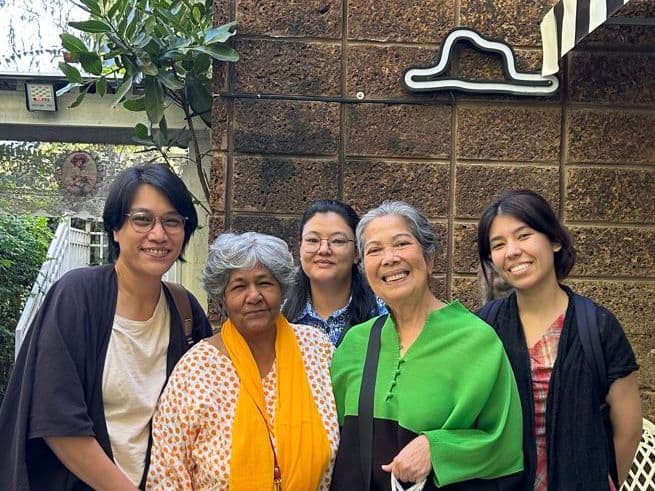
Sanila Gurung is the Women Interrogating Trade and Corporate Hegemony Program Officer at the Asia Pacific Forum on Women, Law and Development (APWLD). APWLD has been a member of the Gender and Trade Coalition since 2018, and is currently one of our 13 Steering Committee Group members.
How did your organization come to work on gender and trade justice?
For almost four decades, APWLD and our members have consistently resisted and fought against mega-regional free trade agreements such as the Regional Comprehensive Economic Partnership (RCEP) and the Comprehensive and Progressive Agreement for Trans-Pacific Partnership (CTPPA). Over the time, we have organized Civil Society Organizations (CSO) forums and workshops in India, Thailand, and Indonesia against the backdrop of RCEP negotiations to strengthen feminist analysis; collaborated with mainstream media to shift the narrative on trade and development; empowered and mobilized our members and allies to lobby negotiators; led and garnered support in our call to resist the World Trade Organization (WTO) Declaration on Women Economic Empowerment; and examined the geopolitical shift regarding economic power and analyzed the role of China.
More recently, in 2019, APWLD launched Women Interrogating Trade and Corporate Hegemony (WITCH), an initiative focused on building the capacity of women’s rights organizations and feminist movements to critically examine and halt the growing influence of corporations and the impact of trade and investment rules on women’s rights. So far, we have worked with four organizations and their communities to document the impact of corporate hegemony on women’s human rights at the local level, as well as community-owned solutions for economic justice. WITCH draws and builds on the many years of grassroots experience and feminist analysis of trade and investment rules that made APWLD a leading voice on gender and trade, both regionally and globally.
What are some of your recent actions and/or achievements in the struggle towards gender and trade justice?
APWLD is a network organization where members identify and prioritize issues. For the 2022-2026 strategy, we convened with members and allies to collect more insights on key areas impacted by trade within communities. We identified food sovereignty, digitalization, and militarism as the thematic focus, which we are now examining through the WITCH program. Additionally, our members aim to address the transversal impact of colonialism, imperialism, and neoliberalism on women.
In the realm of food sovereignty, we have completed our Feminist Participatory Action Research (FPAR), which clearly illustrates the impacts of the implementation of the WTO's Agreement on Agriculture, bilateral and free trade agreements, and how national laws and policies have been modified to adapt to these agreements, affecting community women as a consequence. Now, we are further investigating the impact of imperialism and neoliberal policies on the communities and their effects on the labor rights of women. Similarly, trade and militarism are intertwined—there are complex relationships between trade policies and military strategies influencing regional stability, socio-economic development, and human rights in the Asia Pacific region. To address this topic, we facilitated capacity-building during the Asia Pacific Feminist Forum and are now developing a paper on trade and militarism and their implications for women. Regarding trade and digitalization, we are working to gather information as many new agreements have recently incorporated e-commerce into their content.
Furthermore, we have also monitored the negotiations for the Indo-Pacific Economic Framework (IPEF) at the regional level, since many countries in the region are part of it. Although the negotiation process has been restrictive for civil society organizations and challenging to navigate, we were involved in it in Indonesia and Thailand. Additionally, we have conducted parliamentary roundtable discussions with Members of Parliament from the Philippines, South Korea, and Thailand to explore how to enhance transparency in the process and exert influence on it. Finally, en route to the 4th International Conference on Financing for Development (FfD), we organized various engagement activities at the regional level with our allies and members to address debt and trade issues.
In your opinion, what is the GTC’s contribution to fighting against unjust trade policies?
The GTC fosters a space and enables the movement to advocate for policy change. It provides this unique environment for various organizations, activists, and academics to discuss, exchange knowledge and analysis, and collectively tackle unjust trade policies to protect and promote women's human rights.
In addition, many mega-trade and bilateral trade agreements are occurring behind the scenes without transparency, and the consequences of these agreements are being borne by the people of the Global South, particularly women. In the current context of the trade war and precarity, collectives such as the GTC are key. Being in community makes it easier for us to be vigilant and take proactive steps in addressing unjust trade policies.